 AW Holding


B2B Legal debt settlement services in Dubai for businesses refer to legal solution provided by debt settlement companies that help businesses resolve outstanding debts with other businesses or entities in a legal and efficient manner as alternative for expensive litigation.
These debt collection agencies in UAE can save a lot of money for businesses experiencing financial difficulties due to unpaid invoices, contracts & corporate disputes, or other debt-related issues.
In this article, we will have a closer look at what this B2B legal debt settlement service in Dubai entails.
How does the normal litigation instead of legal debt settlement cost your corporate time, money, and business relationships?
Onboarding Timeline & Process
Imagine you decided to take the legal path to recover your outstanding debts, you will be start looking for a law firm to represent your corporate, this process that starts from searching for law firms, to conduct meetings, evaluation, negotiating professional fees, assessing and taking decision until onboarding can take from 3 month to 6.
Unless you do have an established relationship with a legal representative or took a recommendation from business partner to deal with specific firm this will take from 3 to 7 business days approximately for straightforward commercial files and singing a contract.
Litigation & Execution Timelines in the UAE
Then the law firm will start verifying corporate documentation, trade licenses, runs conflict-of-interest checks, review contracts, purchase orders, delivery receipts, and invoices to verify that the claim satisfies local procedural thresholds.
The law firms on most cases will advise the clients to go to court and start litigation process no matter what are the case situation and condition and they would refuse any trial of amicable solution even if the debtor shows high potentials for solving amicably and reaching a signed and binding mutual agreement, as traditional lawyers tend to guarantee higher professional fees through following the court and litigation path.
So, in this case the client must execute a formal Power of Attorney authorizing the legal counsel to represent them before UAE Notaries Public and courts (often requiring notarization and attestation via systems like Dubai Notary or local UAE embassies if foreign issued).
Under UAE civil procedure, if the debt is proven by a signed commercial contract and an explicit outstanding invoice, lawyers can apply for a Payment Order. This can yield a court order in as little as 1 to 3 weeks, provided the debtor is properly notified and given a mandatory 5-day grace period to settle.
If the debt is contested or complex, standard court litigation takes 3 to 6 months (and occasionally longer through appeal stages).
Winning a judgment is only half of the battle. Initiating execution proceedings (asset freezing, bank garnishments, travel bans) adds another 1 to 3 months depending on the debtor’s liquidity and asset visibility.
All of this and we are only talking about domestic cases, but when the debtor flew to another country, that’s a whole different scenario, as the new destination follows different jurisdiction, you will have to play by their roles and find a local player that take this match on your behalf, so all of the previous timeline we have discussed above will be doubled or tripled based on the new jurisdiction.
Litigation Financial Expenses and Cost Breakdown
Failing to recover the debt by a legal debt settlement introduces significant upfront and hidden financial expenses:
- Legal Retainers & Fees: Law firm retainers for commercial civil litigation typically start anywhere from AED 10,000 to unknown depending on the complexity and claim size or involve agreed contingency structures.
- Court & Administrative Fees: UAE courts charge fixed filing fees (e.g., standard onshore court fees are typically calculated as a percentage around 6% of the claim amount, capped by local guidelines).
- Translation & Expert Fees: Document translation (Arabic is mandatory for UAE courts) and court-appointed accounting experts can add thousands of dirhams in out-of-pocket costs.
- The Recovery Gap: While courts often order the losing party to cover legal costs, the awarded amount is usually a nominal fixed fee (often between AED 1,000 and AED 5,000) rather than full coverage of your actual attorney fees.
All of these expenses depends on the size and brand capacity of the law firm that your corporate is hiring, and remember we’re still talking locally inside the UAE, but again if the debtor plays in different jurisdiction that’s a whole different fee structure.
Relationship Damage and Commercial Fallout
Escalating straight to a lawsuit carries severe relational and operational consequences:
- Permanent Burned Bridges: Initiating formal litigation instantly terminates any possibility of future commercial collaboration. For B2B partners who might otherwise experience temporary cash flow dips, legal action closes the door permanently.
- Reputational Friction: Formal court filings or execution notices can trigger negative market rumors within tight-knit industry sectors.
- Counter-Litigation Risks: If internal credit control documentation is weak, or if debt collection attempts previously crossed compliance lines (e.g., harassment or unauthorized claims), the debtor may file counter-claims, tying up company resources in defensive legal battles.
So, what is the B2B Legal Debt Settlement service offered instead?
Opting for a legal debt settlement instead of full courtroom litigation shifts the financial and operational recovery dynamic entirely. Below is a structured breakdown comparing legal debt settlements to standard litigation across timeline, cost, and business relationship management.
Legal Debt Settlement Timeline:
When your case shifted from an internal collection team to legal debt settlement team, they don’t start all over again, the cases are hand delivered with full analysis and reporting status about the debtor’s business situation, financial abilities, and willingness to pay.
How many broken promises have made, the line of communication that have been made with the debtors over the past 1 to the 3 months from phone calls, emails, field visits and detailed reporting about actions and response from the debtor side with full documentation of every single contact attempt, so the legal debt settlement team, start from the delivery point not from the start point on these cases.
Instead of waiting months for court dockets, discovery phases, and judge rulings, the B2B legal debt settlement service team drafts a formal settlement proposal (such as a structured payment plan or a discounted lump-sum release). Once agreed upon, the document can be rapidly formalized or endorsed, so it holds direct executive power without dragging through trial cycles.
Even if the debtor refused it in the first place, the legal debt settlement team leaves the door open and continues to pressure on the debtor side to cut the process short and agree on signing the settlement to save the timeline.
Financial Expenses and Cost Efficiency:
- Cost Structure: Significantly lower than full litigation. Legal fees are usually restricted to negotiation and precise contract drafting rather than retainer-heavy court representations, expert witness costs, or percentage-based court filing fees.
- Net Return: For mid-sized or constrained claims, full litigation expenses can consume a massive portion of the recovered capital. A negotiated settlement preserves cash flow by avoiding prolonged legal overhead, ensuring that a larger percentage of the recovered funds returns to your working capital.
AW Holding INT’L Risk-Sharing & Contingency Models:
Businesses are often hesitant to risk thousands of dirhams on unpredictable legal retainers and court fees with no guarantee of recovery. To remove this financial barrier, AW Holding INT’L operates on flexible, results-driven risk-sharing models tailored to your portfolio’s risk profile and cash flow needs.
We offer three primary funding structures designed to protect your balance sheet, if your case aligns with set or conditions and requirements that are shared afterwards and confirm your case eligibility for it.
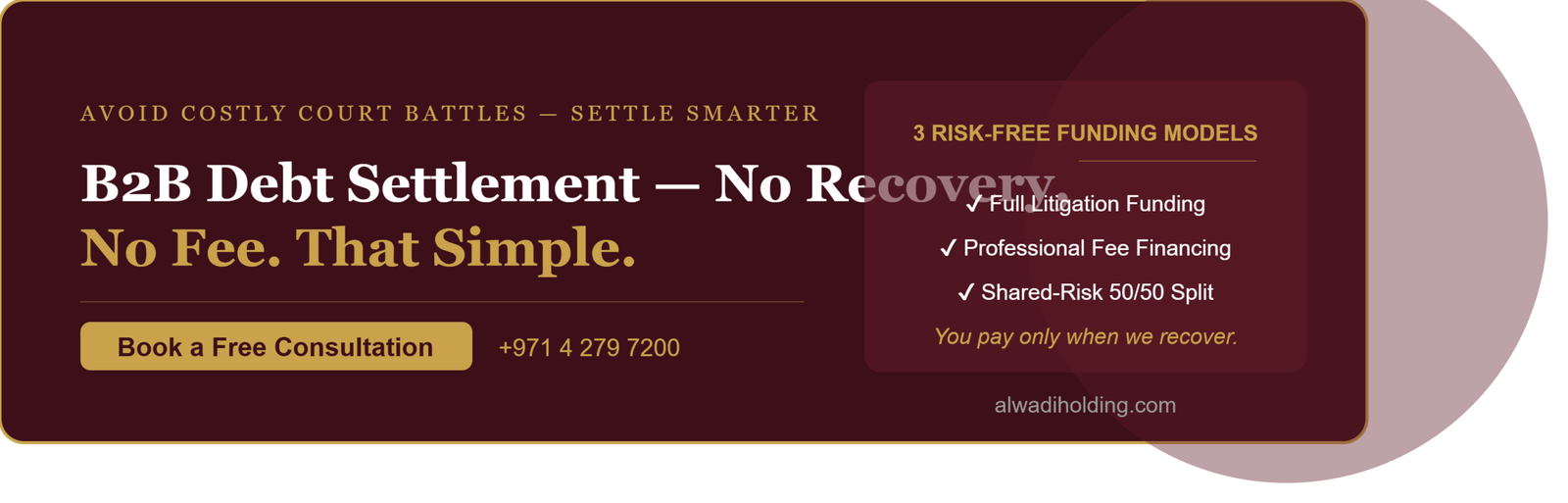
1 – Full Litigation Funding Model:
AW Holding INT’L covers 100% of the litigation process, court fees, and legal expenses upfront. We take the entire financial risk of the lawsuit, and in exchange, we receive an agreed-upon percentage only after the funds are successfully collected. If nothing is recovered, you owe nothing for the legal proceedings.
2 – Professional Fee Financing Model:
We fund all professional legal and administrative fees required to build and execute the case, operating entirely on a contingency basis. This ensures your internal accounts’ receivable budget remains untouched while expert legal teams manage the enforcement process, in return we receive also a percentage only after the debt is successfully collected, that percentage covers the whole professional fees.
- Shared-Risk (50/50 Split) Fee Model:
For clients seeking a balanced approach, we fund 50% of the legal and professional fees upfront, with the remaining costs recovered directly from the collected payout upon successful resolution. This hybrid model lowers immediate overhead while maintaining a shared commitment to a high-yield recovery.
B2B Legal Debt Settlement Service keeps your Business and Commercial Relationships:
Preserving Partnerships: Unlike an aggressive lawsuit that creates permanent hostility, a negotiated settlement handles delinquency pragmatically. It acknowledges cash flow temporary crunches while holding the debtor accountable, so we settle what’s have been sold and continue extending credit on sale with new conditions and limits normally.
Future Commercial Viability: Because the resolution is reached through structured diplomacy and mutual compromise rather than a court-mandated asset seizure, businesses can often salvage the working relationship, allowing for future commercial transactions once financial stability returns to the debtor’s side.
Final word:
So, after the fill comparison we have went through in this article, everything in terms of cost, time and client relationship now become crystal clear to help you decide what is best for your corporate in terms of escalating B2B debts to retrieve, take a closer look on the article again, assess and take your time to decide.
Or you may give us a call, listen to what we can offer, and decide later; we are sure we can help.
Contact us and have an online meeting with our legal department now.